
Neuro Linguistic Programming (NLP) is defined as a practical model of the processes we experience, to experience reality.
Neuro Linguistic Programming describes how to recognize, use and change mental programming.
Developed by Richard Bandler and John Grinder during the seventies, the name NLP symbolizes the form of mental programs: Neurological experiences sorted and interpreted through structured communication.
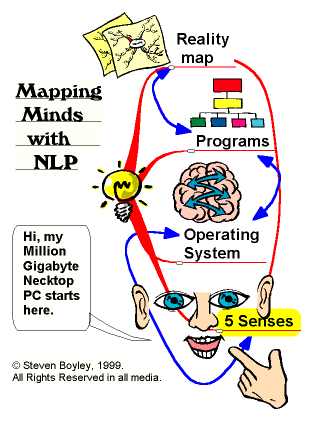
- Neuro: Reality is processed by our five senses and nervous system into experience.
- Linguistic: Our experience is coded, organized and given meaning by language and non-verbal communication systems.
- Programming: Discovering, using and changing our behavior, language and non-verbal communication systems to achieve desired outcomes or directions.
Neuro Linguistic Programming is comprised of two recursive loops.
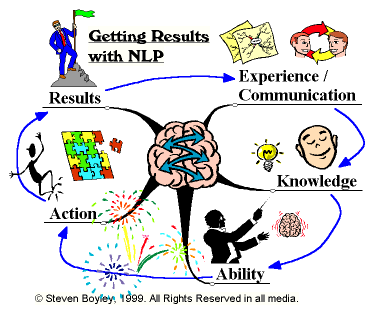
The first loop is the structure of internal experiences and the second loop is the structure of external experiences, caused by the first loop. The first loop feeds into the second loop, which then feeds back into the first loop, which then feeds back into the second loop again, and so on.
The First NLP Loop. Internal Experience & Communication.
The Second NLP Loop. External Experience & Communication.
Neuro Linguistic Programming is an attitude, a methodology & a technology.
- An attitude characterized by a sense of curiosity and adventure and a desire to learn how to find out what kinds of communication influences somebody and the kinds of things worth knowing… to look at life as a rare and unprecedented opportunity to learn.
- A methodology based on the overall operating presupposition that all behavior has a structure… and that structure can be modeled, learned, taught, and changed. The way to know what will be useful and effective are the perceptual skills.
- An innovative technology enabling the practitioner to organize information and perceptions in ways that allow them to achieve results that were once inconceivable.
Fortune 500 companies and many professions are getting NLP training.
They want to guarantee that their executives, managers, trainers, salespeople, facilitators and customer service staff, have a competitive edge. NLP is now required learning according to top performers in persuasion, education, management, marketing, sales, law, health care, therapy etc
- Take effective action in spite of fear.
- Behave confidently in any situation.
- Create pervasive, positive changes.
- Rapidly acquire skills and strategies.
- Achieve goals elegantly and easily.
Success depends on a person’s ability to communicate, with themselves and with others. Learn the structure of that experience and how to use it. Understanding how the brain works and the language that drives it, creates new ways of maximizing your effectiveness.
NLP is powerful!
NLP is:
Information that powerfully transforms thought, behavior and language.
An amazing tool to acquire new behavioral capabilities.
A way to change perceptions of experiences.
A way to control unconscious mind.
“The power tools” in business.
Persuading capability.
Skill modeling tools.
Rapid learning.
Awareness.
Creativity.
Healing
Fun!
Society of NLP (SNLP)
 The Society of NLP (SNLP) was established in 1978 and exerts quality control over NLP training programs and services. Society of NLP – Richard Bandler approved institutes and centers, advertise the Society of NLP seal (above) to indicate Society Certification. … Continue reading
NLP Presuppositions
 NLP presuppositions form the basic attitude of NLP Practitioners. These presuppositions are considered to be useful ideas, the NLP basics. The first of the NLP presuppositions, is that the following ideas are presuppositions about reality. The second of the NLP … Continue reading
NLP Models
 NLP models describe systems, theories, or phenomenon, account for their properties and may be used to further study their characteristics. This image outlines several NLP models. The Meta Model describes the transformation of reality into subjective experience. The Meta Programs … Continue reading
NLP Meta Model: Subjective Experience
 The NLP Meta Model describes the process people use to experience reality: Deletion, distortion & generalization. According to the NLP Meta Model, we start arriving at our model/map of reality through deleting reality. Leave out or ignore may be physically … Continue reading
NLP Strategies
 NLP strategies are descriptions of the sequences of thoughts and actions people use to achieve specific outcomes. The distinctions of NLP models are used to describe the strategies. This description is called an “NLP strategy”. Everyone is familiar with descriptions … Continue reading
NLP Techniques
 NLP techniques are practical methods, the art, of applying NLP skills. NLP practitioners with a high degree of ability and experience, can apply NLP skills using a variety of NLP techniques. Different contexts may require different approaches. Accomplishing the same … Continue reading
Hypnosis, Hypnotize, Hypnotism And Hypnotist Definitions.
 Hypnosis is the effect produced by the hypnotism skills of a hypnotist. Defining hypnotism as a function of hypnosis, the state that is produced by the hypnotist… is like defining a light source by focusing on whatever it is shining … Continue reading
NLP Courses Online
 NLP courses online develop your influence and personal power. Why wait? Get results now! Sharpen your edge with NLP courses online. Training for business and personal change. Get personal coaching online with Steve Boyley. Experience how easily you can learn … Continue reading
NLP Forum
 NLP Forum Discussion Group JOIN this NLP forum. The best NLP Trainers in the world are members of this forum. NLP Enthusiasts join this NLP forum for more information about NLP, to enjoy the discussions and to ask questions. This … Continue reading